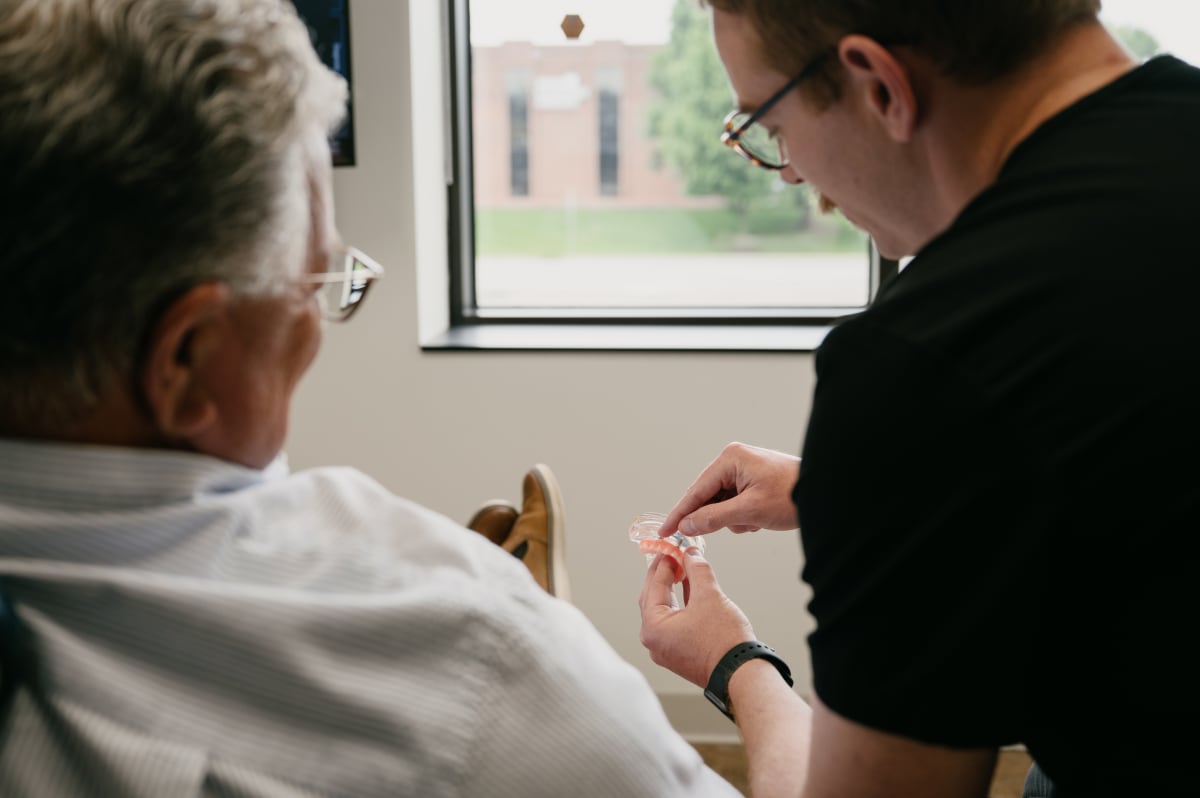
Dentures vs All-On-X: Why Fixed Teeth Change Everything
All-inclusive Dentistry in Indianapolis
.svg)
The Moment You Start Hiding Your Smile
You might know the feeling. Someone pulls out a phone for a group photo and your first instinct is to step back, turn slightly, or laugh with your hand covering your mouth. Maybe you've found yourself steering clear of certain restaurants because the menu is full of things you can't comfortably chew. Or perhaps you've passed on a networking dinner, not because you were busy, but because eating in front of colleagues felt like too much to manage. These can feel like small inconveniences, but for people who invest heavily in their careers and how they show up professionally, they often carry a real cost.
If you're researching tooth replacement options, you may have noticed that the conversation often starts with cost comparisons or technical specifications. But the real question worth asking first might be simpler: which solution actually lets you stop thinking about your teeth?
We work with patients across the Indianapolis area who are ready to stop working around their smile and start trusting it again. The decision between dentures and All-On-X isn't just clinical. It's about how you want to show up in your life, and that conversation deserves more than surface-level comparisons.
What You'll Learn in This Guide
- The mechanical difference: Why "fixed" vs "removable" changes everything about daily function
- Maintenance reality: What you're actually signing up for with each option long-term
- Bone health impact: How your jawbone factors into the decision and your future options
- Total cost perspective: Moving beyond sticker price to understand lifetime investment
- Candidacy factors: What determines whether All-On-X is right for your situation
- Next steps: How to have the right conversation with the right provider
What 'Fixed' Actually Means (and Why It's Not Just a Preference)
There's a mechanical reality behind that word "fixed" that can change the entire conversation about tooth replacement. The difference between All-On-X implants and conventional dentures isn't about aesthetics or personal taste. It's about how the two solutions interact with your body at a structural level.
If you've been told that implants are "more complex" than dentures, that's technically true, but complexity isn't automatically a negative. The question is whether that complexity serves a purpose that may matter to your daily life.
Dentures sit on top of the gum tissue. They rely on suction, adhesive, or a combination of both to stay in place. That means they can shift when you chew, slip when you speak, and may require a mental adjustment every time you use them. Your brain may never fully register them as part of you.
All-On-X implants work differently. Titanium posts are placed directly into the jawbone, and the full arch of teeth is secured to those posts. Nothing moves. The result is a restoration that functions the way natural teeth function. When you chew, the force travels through the implant and into the bone, providing the stimulation that keeps bone tissue dense over time.
The comparison comes down to this: which option actually behaves like teeth? You can read more about how dental implants address these structural concerns.
The Maintenance Reality Nobody Warns You About
Implants are not a zero-maintenance solution. Anyone who tells you otherwise isn't being straight with you, and if you've already done your research, you may have sensed that. The more useful question isn't "which option requires less work?" It's "what kind of work am I actually signing up for?"
Many patients worry about hidden maintenance costs or complicated care routines they weren't told about upfront. Understanding the real daily and long-term requirements helps you budget both time and money accurately.
With traditional dentures, the daily routine typically includes:
- Removing them every night
- Soaking them in a cleaning solution
- Managing adhesive to keep them stable throughout the day
- Returning for periodic relining as the fit changes
That last point can catch people off guard. Maintenance isn't just about cleanliness. It's about chasing a moving target.
All-On-X implant bridges require consistent care too: daily brushing, flossing underneath the bridge with specialized tools like water flossers or interdental brushes, and regular professional cleanings. But the routine tends to be more stable. What you establish in year one is generally what you maintain in year ten.
The difference is in kind, not just in effort. One routine maintains what you have. The other helps protect what you've invested in. Our patient reviews often reflect that distinction once people are a year or two into their decision, and it's a perspective worth considering before you choose.
How Your Jawbone Factors Into the Decision
Long-term satisfaction with tooth replacement often depends on more than how something feels in year one. It's also about what's happening beneath the surface, in the jawbone itself, over the years that follow. If you're feeling overwhelmed by the technical aspects of this decision, you're not alone. Understanding bone health can be one of the most complex parts of treatment planning, but it's also one of the most important.
Your jawbone stays dense and healthy because of the stimulation it receives every time you chew. When a tooth is lost, that signal disappears. Without it, the bone gradually begins to shrink and remodel itself. Dentists call this process resorption, and it happens quietly, without any pain or obvious warning signs.
This is why people who have worn dentures for many years might notice changes in the appearance of their lower face. The structure that once supported everything from the outside can slowly diminish from within.
What this means practically: if you've been missing teeth for several years, some bone loss may have already occurred. That doesn't necessarily disqualify you from implants, but it can affect the treatment plan. A 3D scan can show exactly where you stand and what options might be realistic for your situation.
If you're thinking about what your jaw might look like not just this year but a decade from now, that distinction can carry real weight in the decision.
The Cost Conversation You Need to Have With Yourself
While the Indy Dental Health team can walk you through the specifics, it helps to come in with a clear framework for thinking about cost. This is one area where the conventional comparison can mislead people.
Yes, All-On-X typically carries a higher upfront investment than traditional dentures. That's real, and any honest conversation has to start there. But as you may know from other major purchases, sticker price and total cost of ownership are two different numbers.
Dentures aren't a one-time purchase. The ongoing expenses can add up in ways that aren't always visible at the point of decision:
- Daily maintenance products: adhesives, cleansers, soaking solutions
- Periodic relines every 2-3 years as fit changes
- Full replacements when the appliance wears out
- Potential downstream costs from ongoing structural changes
All-On-X implants typically have a longer functional lifespan and greater stability over time. What matters most is making the decision with the full picture in front of you, not just the first number you see.
Who Is Actually a Candidate for All-On-X?
Having the full picture means understanding not just what All-On-X can do, but whether it might be the right fit for where you are right now. Not everyone who walks into a consultation will be cleared for implants on the same timeline, and we believe in being transparent about that upfront. The uncertainty around candidacy is one of the biggest concerns patients bring to consultations, and it benefits from clear information.
The foundation of any implant procedure is adequate bone structure. People who have worn traditional dentures for years sometimes hit a pause point here, but that doesn't automatically disqualify someone. Bone grafting may restore enough volume to make implants viable, though it does add steps to the process and additional healing time.
A consultation for All-on-X in Indianapolis evaluates several key factors:
- Overall systemic health, including conditions that may affect healing (diabetes, autoimmune conditions, smoking history)
- Commitment to long-term oral hygiene and follow-up care
- Realistic expectations about the process timeline and recovery requirements
The goal isn't to qualify as many people as possible. It's to make sure the people who move forward are genuinely set up for a good outcome. Dr. Matthew Fraiz and Dr. Brian Fraiz find that many patients appreciate knowing exactly where they stand before making any financial commitments.
Key Candidacy Considerations
- Bone foundation: Adequate jawbone density is essential, but bone grafting may address deficiencies
- Health factors: Certain medical conditions may require additional planning or healing time
- Commitment level: Success typically depends on following post-treatment care and maintenance protocols
- Timeline expectations: The process typically takes several months from start to final restoration
Ready to Find Out Which Option Actually Fits Your Life?
A good outcome often starts with having the right conversation with the right people. That conversation looks different for everyone, because what you want your next decade to look like is specific to you.
The choice between dentures and All-On-X may be about how you want to show up at work, at dinner, on a weekend trip. Those are the kinds of details worth talking through before you decide anything.
Our consultations are built around that kind of comparison. You bring your questions, and we work through the options with your specific situation in front of us. No pressure, just information you can use to make an informed decision.
Before your consultation, consider bringing any recent X-rays, a list of current medications, and questions about your specific concerns. Whether that's recovery time or how the treatment fits with your work schedule, these details can help us give you the most relevant guidance.
What to Expect From Your Consultation
- Comprehensive evaluation: Complete assessment and candidacy review
- Clear pricing: Upfront costs and payment options
- Realistic timeline: What the process looks like from start to finish
- Alternative options: If All-On-X isn't right for you, what other paths make sense
Three locations serve the Indianapolis area, so reach out to whichever is closest to you:
- Indianapolis: 9333 N Meridian St, Suite #225, (317) 872-3465
- Shelbyville: 122 Lee Blvd , (317) 398-6399
- Greenwood: 997 E County Line Rd, Suite L , (317) 865-1193
When you're ready to dig into the specifics, we're here to help you make the decision that's right for your life.
.jpg)
convenient
We invite you to enjoy trusted professionals, personalized treatment, and a great dental experience with three convenient locations to fit your life.

We can’t wait meet you
Request an appointment online to set up your first visit. We’ll be in touch soon.
schedule Appointment